Why Do Some Financial Plans Survive Change—While Others Don't?
The Soil & The Seed: A Simple Framework for Building Financial Stability That Lasts
When I first started working with RT and Em several years ago, they were recovering from a government shutdown that had interrupted their income. They had only a few hundred dollars in their checking account, growing debt, and very little room to absorb another disruption.
We didn't begin by talking about investing or retirement. We started by understanding their cash flow. Together, we identified hundreds of dollars each month that were quietly disappearing without serving the family's priorities. They redirected those dollars toward paying down debt and building an emergency fund.
Fast forward to this year. They took their first family vacation in nearly twenty years. Then another government shutdown lasted more than two and a half months. This time, they weathered it without taking on additional debt.
Their income hadn't changed dramatically.
The structure underneath it had.
That experience reinforced something I've seen repeatedly over the years. People often assume financial success is measured primarily by growth: larger investment balances, higher income, or increasing net worth. Those things certainly matter. But they aren't what determine whether a financial plan survives change.
Structure does.
Over time, I began thinking about financial planning through a simple framework I now call The Soil & The Seed.
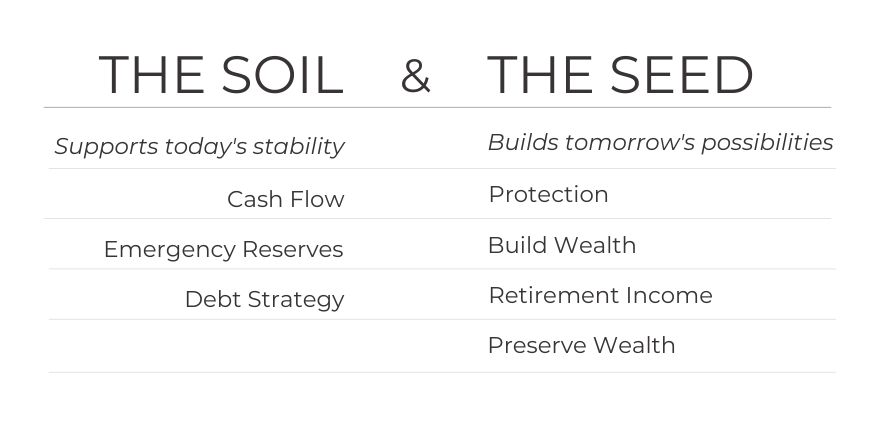
Before anything grows, something has to support it. Farmers know that even the healthiest seed struggles in poor soil. The soil doesn't produce the harvest, but it creates the conditions that allow the harvest to happen. Financial life works much the same way.
The Soil
Most conversations about money naturally focus on growth. Yet growth is only one job a financial system must accomplish. Before long-term goals can flourish, the underlying structure has to be capable of absorbing life's inevitable interruptions.
Healthy financial soil is built by:
creating margin between income and expenses
preparing cash reserves for interruptions
reducing obligations that create ongoing pressure and limit future choices
None of these topics generate much excitement. Yet they often determine whether a temporary interruption becomes a temporary inconvenience, or a long-term financial setback.
RT and Em's story illustrates this well. The government shutdown didn't disappear. What changed was their ability to absorb it. Their emergency fund bought time. Lower debt reduced pressure. Positive cash flow created flexibility. Together, those pieces transformed an interruption that once created crisis into one they could manage.
Only after strengthening that foundation did we begin intentionally building for the future. We started with affordable term life insurance to protect the family if one spouse died unexpectedly. As their financial margin increased, they began directing additional dollars toward longer-term savings and investments.
The soil made it possible to plant seed.
The Seed
If soil helps a family withstand today's interruptions, seed is planted to prepare for tomorrow's opportunities and responsibilities.
Healthy seed is planted to:
build long-term wealth
create future income
provide resources for changing seasons of life
care for the people who depend on us
One part of the framework often surprises people.
Many assume the first seed to plant is investing. I often recommend beginning with protection.
That may seem counterintuitive until we remember what seed is designed to accomplish. Seed isn't simply about growth. It's about creating future resources. Properly designed protection creates future liquidity, preserves choices during serious illness or death, and helps ensure that years of progress aren't undone by a single event.
James and Mary understood this well. They were raising two young children while operating three small businesses. For James, purchasing life insurance wasn't primarily about insurance. It was about knowing that if something happened to him—or if serious illness changed his ability to work—his wife, children, and mother-in-law would have the resources and flexibility to continue making thoughtful decisions.
Protection wasn't replacing growth.
It was protecting the future they were building.
Don't Eat the Seed
The opposite pattern appears just as often.
James called one afternoon about a friend who had recently left a job and wasn't sure what to do with an old retirement account. We discussed the four common options: leave it where it was, move it to a new employer's plan, roll it into an IRA, or cash it out. My advice was simple: if at all possible, avoid cashing it out. Taxes, penalties, and the loss of future growth usually make it the most expensive choice.
A few weeks later, I talked to James again.
His friend had cashed it out anyway.
Not because it was the best long-term decision.
Because he needed money now.
I've seen versions of that story many times. People rarely cash out retirement savings because they don't care about retirement. They do it because today's pressure is stronger than tomorrow's plans.
In other words, they consume resources that were intended to provide for the future because the present has nowhere else to turn.
The problem isn't the retirement account.
The problem is that the financial soil wasn't strong enough to absorb the interruption.
A Better Way to Think About Financial Planning
One of the biggest misconceptions in financial planning is that the goal is to find the perfect product. I don't believe that's the right question.
Some financial resources are remarkably versatile. Others are intentionally specialized. A business may generate income, appreciate in value, create tax advantages, and eventually help fund retirement. Certain forms of permanent life insurance can provide protection, tax-advantaged accumulation, living benefits, access to capital, and estate liquidity. Emergency savings create liquidity, reduce stress, and protect long-term investments from being interrupted.
The goal isn't to find one resource that does everything.
Nor is it to expect every resource to do only one thing.
The goal is to make sure the important responsibilities in a family's financial life are covered by resources that are well suited to fulfill them. Some resources will naturally carry several responsibilities. Others will carry only one or two. What matters is that the system works together.
That's where many financial plans begin to change.
Some people focus almost entirely on growth while neglecting the foundation that supports it. Others build strong financial discipline but never intentionally invest for the future. Still others expect a single resource—a business, a retirement account, or one financial product—to carry responsibilities it was never designed to bear.
Healthy financial systems rarely depend on any one piece.
They depend on the pieces working together.
Financial planning, then, is not primarily about accumulating products or opening more accounts. It's about intentionally designing a system in which today's needs, tomorrow's opportunities, and life's inevitable interruptions have all been thoughtfully considered.
That's what The Soil & The Seed has come to mean to me.
Not a product strategy.
A way of thinking.
A framework for building financial systems that are designed not only to grow—but to continue through change.
Toward greater clarity,
Sarah
